One Gear Blog
The market moved from "add more beds" to "fill the ones you have"
For a long time, Croatian tourism ran on a simple rule: if you had a bed, you had a guest. That arithmetic has changed — though not in the way most people assume.
What actually happened to supply
Contrary to expectations, supply stopped expanding. According to the Croatian National Tourist Board, the number of beds in private accommodation fell this year for the first time — from 667,598 to 657,598, some ten thousand fewer in twelve months. The cause is a set of tax and legal changes aimed at curbing short-term rentals in towns under tourist pressure.
At the same time, 2025 was a record season: 94.8 million overnight stays and 21.4 million visitors. And, perhaps most importantly, occupancy in private accommodation is rising for the first time since 2018.
Those three facts together change the business. You are no longer competing for space in a market that keeps filling with new listings — you are competing for occupancy of the capacity you already have. That is an entirely different skill.
Where the commission goes
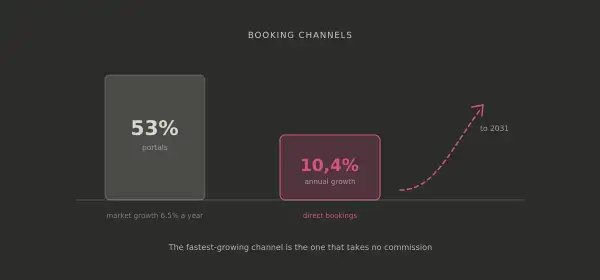
According to hospitality market analysis, booking portals currently account for about 53 percent of all bookings in Croatia. Direct digital bookings take a smaller share, but they are growing at 10.4 percent a year through 2031 — nearly twice the pace of the market overall, which grows at 6.5 percent.
Put plainly: the fastest-growing channel is the one that takes no commission.
None of this makes portals the enemy. They do one thing better than anyone: they bring guests who did not know you existed. The problem is the guests who did. The one who searched for your house by name, saw it in a friend's photograph, or stayed with you last summer — that guest is yours, and you are still paying commission on them.
On a house with twenty bookings a season, at nightly rates that are not small in July, that difference compounds into a serious line item.
What your own platform actually changes
Commission on returning guests disappears. Someone who already knows you books directly. On repeat guests that is pure saving.
You control the price. Open a date, drop the rate for a slow week, run a long-stay or early-bird discount — with no platform rules and no waiting for a change to be approved somewhere.
Guest data stays with you. Email address, language, previous stays, small preferences. A portal does not hand you that. Without it there is no newsletter, no offer for returning guests, nothing but waiting for next season.
You tell the story. On a portal you are a row in a table among a hundred similar ones. On your own site you decide what is seen first, how the view from the terrace looks, and why your house is not the one two streets away.
The system grows with you. A new unit gets its own page, enters the calendar and the price list, without a line of code being touched.
What does not change
It would be dishonest to say a website brings guests on its own. It does not. Portals have reach you do not, and there is no point pretending otherwise.
A healthy arrangement looks roughly like this: the portal stays for new arrivals, your own site takes everyone else. Whoever heard of you from a friend, found you on social media, or is coming back a second year — that one books with you. Over time the balance between the two channels shifts, and that shift is exactly what the 10.4 percent figure measures.
Where to start
You do not need everything at once. You need a site that shows the place as it is, a calendar that says precisely what is free, a way to book without emails going back and forth, and content in the languages your guests actually speak.
The rest — discounts, newsletter, more units, reviews — comes later, once the system is already running.
SOURCES: Croatian National Tourist Board, accommodation capacity data (2026); Croatian Bureau of Statistics, tourism 2025; Mordor Intelligence, Croatia Hospitality Market (2026); OECD Economic Surveys: Croatia (2026).
Contact us and OG One Gear Web will work with you to create a website tailored to your needs, with a booking system and everything else a renter needs.
One Gear Blog
Notes from the work, not text written to fill space.
Everything here comes out of actual projects: numbers that surprised me, mistakes that cost something, and decisions that turned out to matter later. If a text cannot help you decide something, it does not get written.
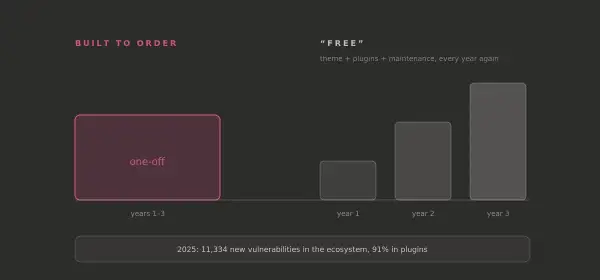
There is no free website. There is only the one you pay for later