One Gear Blog
Ten years ago, a search meant a list. Today it means an answer.
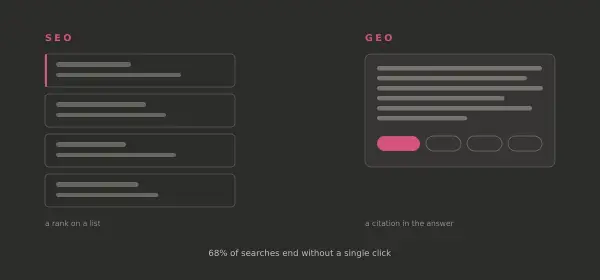
About ten years ago, roughly 45 percent of Google searches ended without a click. Today it is 68 percent. Two out of three people who look something up get their answer and go nowhere — they read it on the results page itself, or in a conversation with an AI assistant.
If you own a website, that is an uncomfortable number. It is also not the whole story, and what is hidden inside it is good news.
What SEO is, and what GEO is
SEO is optimisation for search engines. The goal is to place your page high on the list of results, because most clicks happen in the first three positions. It has been practised for decades and the rules are well known: relevant content, a technically sound site, speed, links pointing to you.
GEO is optimisation for generative engines — the term was coined in 2024 by researchers at Princeton and Georgia Tech in a paper on how AI systems choose their sources. The goal is not a rank but a citation: getting the assistant to use you in the answer it composes. There is no rank there, because there is no list.
The difference is in what you optimise. SEO asks where will we sit on the list. GEO asks will we be used at all when the answer is assembled.
Why you need both
The easy assumption is that one replaced the other. It did not, and the data says so plainly.
There are fewer clicks from search, but the ones that remain are worth more than before. When someone reads an AI summary and clicks anyway, they arrive already informed and closer to a decision. In 2025 Semrush measured across more than five hundred topics that visitors arriving through AI search convert 4.4 times better than traditional organic traffic.
Being cited in an AI answer also helps the ordinary result. An analysis by Seer Interactive found that brands mentioned in an AI summary see roughly 35 percent higher click-through on their own organic result on the same page, compared with brands that are not mentioned.
In other words, GEO does not cancel SEO — it amplifies it. And SEO still delivers what GEO cannot: traffic from people who know exactly what they want and intend to land on a site rather than read a summary.
What GEO actually involves
There is no magic and no secret formula. An AI system picks sources it can read reliably, verify and attribute. So what helps is largely what was good practice anyway.
The answer directly under the question. If a subheading is a question, the first sentence below it has to be the answer, not a run-up to it. Models extract passages, not whole pages.
Structured data. Schema.org markup that tells a machine what the business is, what it offers, where it operates and which questions the page answers. It is the one part of a page written for a machine to read.
Your own data, and specifics. A number, a measurement, a price, a deadline, something from practice — something that cannot be copied from elsewhere. General claims exist in a thousand copies and no system will reach for yours.
Named authorship. Text with a name and verifiable experience behind it gets cited more often than anonymous text.
Clean structure and speed. Orderly headings, semantic HTML, pages that load quickly. What a machine cannot read easily, it will not use.
You will notice almost everything on that list is also good SEO. That is the point: a site built properly today works for both channels at once.
What this means for you
If you run a small or mid-sized business, you do not have to pick a side. You need a site legible to both a person and a machine, and content that answers your customers' actual questions instead of describing how long you have been in business.
The most important shift is not technical but editorial. Pages used to be written to be filled. Now they are written to answer — because search engines and AI want the same thing: whoever gives the clearest answer to this question.
SOURCES: SparkToro / Similarweb, Zero-Click Search Study (2026); Semrush, AI Search Study (2025); Seer Interactive (2025); Aggarwal et al., "GEO: Generative Engine Optimization", Princeton / Georgia Tech (2024).
Request a quote for a fully SEO and GEO optimized website with detailed instructions on how to adapt the content to AI machine reading.
One Gear Blog
Notes from the work, not text written to fill space.
Everything here comes out of actual projects: numbers that surprised me, mistakes that cost something, and decisions that turned out to matter later. If a text cannot help you decide something, it does not get written.

There is no free website. There is only the one you pay for later