One Gear Blog
There is no free website. There is only the one you pay for later
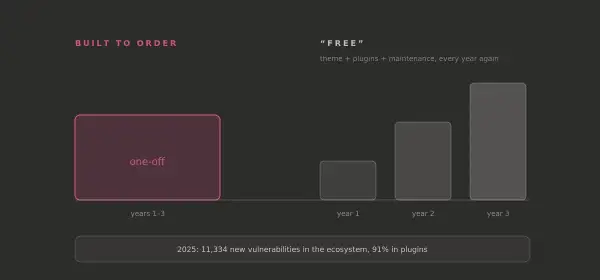
The offer sounds good: the platform is free, a theme costs fifty euros, plugins install in a few clicks. The site is finished in a week and you have saved a few thousand.
The bill, however, does not close that week. It closes over three years — and it almost never looks the way it did at the start.
What actually adds up
The platform itself is free. What you pay for are the parts you have to add to make it do what you had in mind:
A theme. One-off or annual, depending on the author. Serious themes now mostly renew yearly.
A page builder. An annual licence. Without one, most themes look considerably different from the demo you chose them for.
Plugins. Form, gallery, SEO, security, backups, cache, perhaps a shop and multilingual support. Five to ten of them, most with an annual licence for the version that has what you need.
Hosting that can carry the stack. The cheapest plan usually cannot.
Time. This is the item nobody counts. Updates, checking after updates, fixes when two plugins disagree, and an hour or two a month someone has to spend — either you or someone you pay.
The first-year total often looks tolerable. The third-year total looks different, because none of the above is paid only once.
The cost that never appears in a quote
There is another item, harder to put in a table.
Patchstack, which runs the largest vulnerability database for that ecosystem, recorded 11,334 new vulnerabilities during 2025. Ninety-one percent of them were in plugins; the platform core itself had six.
Two more figures from the same report explain why this is not merely statistics:
46 percent of vulnerabilities did not receive a fix before public disclosure, and 1,614 plugins and themes were removed from the official repository — many of which still run on live sites, because their owners never learned they were pulled.
The practical consequence: your exposure is roughly the number of plugins you run multiplied by how quickly you patch them. A site with twelve plugins updated twice a year is not a cheap site; it is a deferred cost.
When a template genuinely makes sense
It would be dishonest to claim an off-the-shelf solution is always wrong. There are situations where it is entirely reasonable:
- You need five pages that will not change.
- You are testing an idea and do not yet know whether it will go anywhere.
- There is no budget and something beats nothing.
- Someone in the company enjoys doing it and has the time.
In those cases take the template and think no further. The harm from an oversized solution is as real as from an undersized one.
When it stops making sense
The line is usually crossed when one of these happens:
- The site earns something — orders, bookings, enquiries that turn into work.
- Content changes weekly, not yearly.
- There are several languages, or several content types with different layouts.
- You need something no plugin does in quite that way.
- Speed or search visibility has become a problem that another plugin will not
solve.
At that point a custom build usually turns out cheaper across three years — not because building is cheap, but because afterwards there are no annual licences, no plugins fighting each other, and no monthly maintenance hour that is really somebody's salary.
How to work it out for yourself
Take a sheet of paper and add up: all annual licences, hosting, and the hours you or someone else spend on maintenance at a realistic rate. Multiply by three.
Then compare that with a one-off quote for a custom build, which over those same three years leaves only hosting and a domain.
Sometimes the template still wins. More often than people expect, it does not.
SOURCES: Patchstack, State of WordPress Security in 2026 and 2025; Wordfence, Quarterly Threat Intelligence Report Q4 2025.
Contact us and request a quote. You will get a serious website that benefits you, without hidden costs.
One Gear Blog
Notes from the work, not text written to fill space.
Everything here comes out of actual projects: numbers that surprised me, mistakes that cost something, and decisions that turned out to matter later. If a text cannot help you decide something, it does not get written.
The market moved from "add more beds" to "fill the ones you have"